

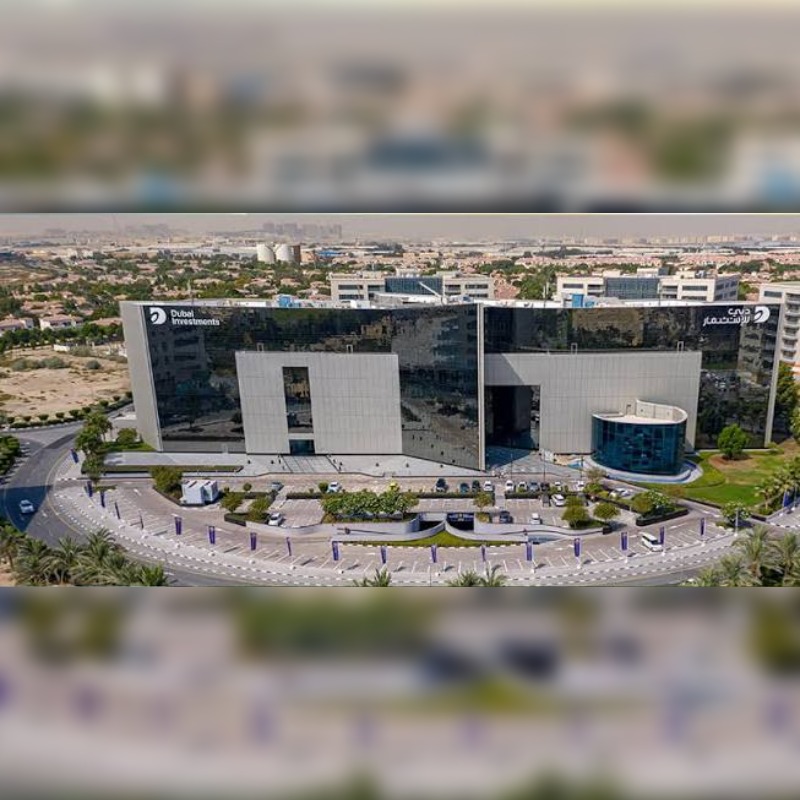
How Dubai Investments Built a Diversified UAE Portfolio From Real Estate to Healthcare
Some companies are easy to describe.
A bank provides financial services.
An airline moves passengers.
A developer builds property.
Dubai Investments is deliberately harder to categorise.
Its portfolio stretches across real estate, industrial manufacturing, healthcare, cooling infrastructure, financial investments and other services.
The group owns or participates in more than 30 subsidiaries, associates and joint ventures.
Its assets reached almost AED 24 billion by the middle of 2026.
What began in 1995 as one of the UAE’s early publicly listed investment companies has gradually developed into a diversified corporate platform closely tied to the country’s physical and economic growth.
This makes Dubai Investments an interesting case study in diversification.
Rather than betting on a single industry, the company has built a portfolio designed to participate in several parts of the UAE economy simultaneously.
The Company Was Created During a Different Dubai
Dubai Investments was incorporated in 1995.
The Dubai of that period looked very different from the global city of today.
Many of the large residential communities, free zones, tourism districts and transport networks that now define the Emirate had not yet been developed.
The UAE economy was also far less diversified.
Creating an investment company capable of supporting multiple industries fit naturally with the country’s long-term development strategy.
As Dubai expanded, the group’s portfolio expanded alongside it.
Diversification Is the Core Business Model
Dubai Investments does not depend entirely on one type of revenue.
Property generates rental income and development profits.
Manufacturing businesses sell materials used in construction and industry.
Healthcare provides exposure to a defensive, population-driven sector.
Investment subsidiaries participate in financial markets.
District cooling generates infrastructure-related income.
This diversification is intentional.
Economic cycles affect industries differently.
Property may experience a strong period while manufacturing faces pressure.
Healthcare demand can remain resilient when discretionary consumer spending weakens.
Recurring rental income can provide stability when development activity slows.
The portfolio is designed to balance these movements.
Dubai Investments Park Became One of the Group’s Defining Assets
One of the company’s most important achievements is Dubai Investments Park.
DIP developed into a major mixed-use industrial, commercial and residential area in Dubai.
Its location provides access to key highways, logistics corridors and major transport infrastructure.
The development hosts manufacturers, warehouses, offices, schools, residential communities and other facilities.
This makes it much more than a conventional property project.
It functions as an economic district.
Businesses can establish industrial or logistics operations while employees and supporting services locate nearby.
Ground-Rent Income Creates Long-Term Visibility
A particularly attractive element of the property portfolio is recurring ground-rent income.
Rather than relying only on selling completed property, Dubai Investments can generate ongoing income from land and infrastructure assets.
This changes the risk profile.
A property sale produces revenue once.
A long-term lease can create cash flow for years.
The company highlighted its ground-rent infrastructure platform as an important contributor to its 2026 performance.
Stable occupancy and recurring payments provide earnings visibility that pure developers often lack.
Recurring Income Supports the Wider Portfolio
Investment companies need reliable cash generation.
Some portfolio businesses may require capital for expansion.
Others may experience temporary weakness.
Recurring property income can provide a financial foundation underneath these more cyclical activities.
This is one reason Dubai Investments’ real-estate strategy matters beyond the value of its buildings and land.
Property can act as a long-term income engine for the entire group.
The Emirates Cabin Crew Village Shows DIP’s Strategic Value
In January 2026, Emirates signed an agreement with Dubai Investments Park for land to develop a new purpose-built Cabin Crew Village.
The planned development represents a multi-billion-dirham investment and is designed to accommodate up to 12,000 cabin crew members.
This is a significant project for several reasons.
It demonstrates the attractiveness of DIP to one of Dubai’s most important companies.
It also adds another large residential community to the district.
Thousands of new residents create demand for retail, services and transportation.
A major tenant can therefore strengthen the wider economic ecosystem surrounding the park.
Real Estate Extends Beyond Dubai Investments Park
The group also develops residential and mixed-use property through Dubai Investments Real Estate and other platforms.
Projects include developments in Dubai and Ras Al Khaimah.
The strategy combines recurring-income assets with properties built for sale.
This gives the group exposure to both rental growth and the UAE’s strong residential property market.
The two models behave differently.
Rental assets produce long-term cash flow.
Development can generate stronger profits when property demand and pricing are favourable.
Danah Bay Brings the Group to Ras Al Khaimah
Danah Bay is one of Dubai Investments’ most significant current developments.
Located on Al Marjan Island in Ras Al Khaimah, the project includes residential and hospitality components.
The location is important.
Ras Al Khaimah has become one of the UAE’s fastest-growing tourism and property markets.
New resorts and entertainment investments are attracting international attention.
Property prices and development activity have responded.
Dubai Investments therefore gains exposure to growth outside its traditional Dubai base.
Ras Al Khaimah Provides Geographic Diversification
Dubai remains the group’s core market, but concentrating entirely on one Emirate would create unnecessary risk.
Ras Al Khaimah offers a different economic story.
Tourism is growing rapidly.
Manufacturing is already important.
International property investors are becoming more active.
Large hospitality projects are changing the destination’s global profile.
Real-estate exposure in RAK allows Dubai Investments to participate in this growth rather than relying solely on Dubai’s property cycle.
Manufacturing Is One of the Group’s Most Distinctive Features
Many investment companies own financial assets.
Dubai Investments also owns factories.
Its industrial portfolio includes companies involved in glass, aluminium, steel, pharmaceuticals, insulation and other building materials.
In 2026, the company described manufacturing, contracting and services as one of its key earnings pillars, contributing close to one-third of total income.
This provides direct exposure to construction and infrastructure activity.
When the UAE builds more towers, warehouses, factories and public infrastructure, several Dubai Investments companies can participate.
The Manufacturing Platform Covers Multiple Materials
The group’s industrial businesses span nine specialised manufacturing companies across six major building-material categories.
This creates an integrated position within construction supply chains.
A property project requires glass.
It needs aluminium profiles.
Steel products may be required.
Insulation materials are needed.
Lighting and other specialised building components may be involved.
Dubai Investments participates across several of these categories rather than depending on a single manufacturing product.
Emirates Float Glass Represents Industrial Scale
Emirates Float Glass is one of the important manufacturing businesses in the portfolio.
Float glass is used extensively in buildings and other industrial applications.
Dubai’s skyline demonstrates why demand can be significant.
Modern towers contain enormous quantities of architectural glass.
The company began construction of a second production line in 2025.
The expansion is expected to make it the only glass manufacturer in the GCC operating dual float lines.
That represents a meaningful increase in production capability.
Glass Demand Is Connected to Regional Construction
UAE manufacturing companies do not serve only the domestic market.
Construction activity across Saudi Arabia, Oman and other regional economies creates additional demand.
Large urban-development programmes require enormous quantities of building materials.
A UAE-based manufacturer can use geographic proximity and established logistics to serve these markets.
This gives Dubai Investments’ industrial portfolio exposure to Gulf construction activity well beyond Dubai itself.
Emirates Extrusion Is Benefiting From Strong Demand
Emirates Extrusion Factory manufactures aluminium profiles used in architectural, engineering and industrial applications.
The company recorded its strongest first-half production performance in a decade during H1 2026.
It also achieved its strongest first-half sales performance over the same period.
At one point, monthly output reached 1,500 metric tonnes, its highest level in ten years.
These results demonstrate how the region’s construction and industrial activity is translating into manufacturing demand.
Aluminium Profiles Are Everywhere in Modern Construction
Aluminium is widely used because it is lightweight, durable and resistant to corrosion.
Window frames, façades and numerous architectural systems depend on aluminium profiles.
Infrastructure and industrial applications use them as well.
Growth in UAE real estate therefore generates demand not only for developers and contractors but also for companies far deeper in the supply chain.
Dubai Investments captures part of this value through manufacturing rather than only property ownership.
Industrial Diversification Supports the UAE Economy
Domestic manufacturing has strategic importance.
Importing every construction material sends economic value abroad.
Local factories keep more of the value chain inside the country.
They create skilled jobs.
They can export products.
They also make regional supply chains more resilient.
The UAE’s industrial strategy increasingly encourages exactly this kind of production.
Dubai Investments was building manufacturing businesses long before industrial diversification became such a prominent policy objective.
Healthcare Is Becoming a Bigger Strategic Pillar
Healthcare represents another important part of the group.
In July 2026, Dubai Investments increased its ownership in Clemenceau Medical Centre Hospital Dubai to 100 percent.
The transaction demonstrates a deeper commitment to the sector.
Healthcare has very different economics from real estate or manufacturing.
Demand is driven by population, medical need and insurance coverage.
It can therefore provide useful diversification.
Clemenceau Medical Centre Strengthens the Healthcare Platform
Clemenceau Medical Centre Dubai is a premium hospital providing specialised medical services.
Full ownership gives Dubai Investments greater control over the business.
The group can determine long-term capital investment, growth and strategic positioning more directly.
Healthcare is particularly attractive in Dubai because the city’s population is increasing while medical tourism continues developing.
Patients from outside the UAE also travel to the country for treatment.
Population Growth Makes Healthcare a Structural Opportunity
Every additional resident ultimately requires healthcare.
Families need paediatric care.
Adults require preventive treatment.
Older populations use more medical services.
Employers provide health insurance.
As Dubai’s population grows, healthcare demand rises with it.
Unlike luxury purchases, many medical services cannot simply be postponed indefinitely.
This gives the sector relatively defensive characteristics.
Medical Tourism Expands the Addressable Market
Dubai does not need to depend entirely on residents.
The city has strong international air connectivity and a large hospitality sector.
These features support medical tourism.
Patients can travel from surrounding countries for specialist treatment.
Hospitals can therefore serve a regional population much larger than Dubai itself.
Premium medical facilities such as Clemenceau Medical Centre can participate in this market.
Globalpharma Provides Pharmaceutical Exposure
Dubai Investments also owns Globalpharma, a UAE pharmaceutical manufacturer.
This extends the healthcare strategy beyond hospitals.
Pharmaceutical production supports another national priority: greater local healthcare resilience.
The pandemic demonstrated the risks associated with depending entirely on international medical supply chains.
Countries increasingly want domestic manufacturing capability for essential medicines.
Globalpharma gives Dubai Investments exposure to this trend.
Globalpharma Is Expanding Internationally
In September 2026, Globalpharma signed an agreement aimed at developing pharmaceutical distribution in Angola.
The initiative demonstrates how a UAE manufacturing business can expand beyond the domestic market.
African pharmaceutical markets offer significant long-term potential.
Populations are growing.
Healthcare access is expanding.
Local supply can remain limited.
An established Gulf manufacturer can potentially build distribution relationships across these markets.
Healthcare Expansion Fits the Group’s Diversification Model
Hospitals and pharmaceutical manufacturing have little in common operationally with property development.
That is precisely why they can be useful inside a diversified group.
Economic conditions affecting property prices do not necessarily influence medicine demand in the same way.
Healthcare therefore provides another source of earnings capable of balancing other portfolio sectors.
The key challenge is ensuring specialist businesses are managed by teams with appropriate expertise.
Emicool Adds Infrastructure Exposure
Another important company in the portfolio is Emirates District Cooling, commonly known as Emicool.
District cooling provides chilled water to buildings from centralised cooling plants.
This can be more energy-efficient than every building operating separate cooling equipment.
The business therefore resembles a utility.
Long-term customer relationships and essential service demand can provide relatively predictable revenue.
Cooling Is Essential in the UAE
Air conditioning is one of the largest sources of electricity consumption in Gulf cities.
Improving cooling efficiency has financial and environmental value.
District cooling centralises production, allowing larger systems to operate more efficiently.
Dubai’s dense master-planned developments are particularly suitable for the model.
Emicool therefore benefits from both property growth and the drive toward more efficient infrastructure.
Emicool Has a Net-Zero Roadmap
In August 2026, Emicool announced a roadmap targeting net-zero operations by 2050.
This reflects a broader shift inside infrastructure industries.
Utility companies are increasingly expected to reduce emissions.
Efficiency improvements, renewable energy and lower-carbon technologies will become more important.
For Dubai Investments, sustainability initiatives can help protect the long-term value of infrastructure assets as environmental standards tighten.
Financial Investments Add Another Layer
Dubai Investments also operates through investment-management and financial platforms.
Al Mal Capital is one of the most prominent.
It provides asset-management and investment-banking capabilities.
This gives the wider group exposure to capital markets rather than only physical operating businesses.
The combination is useful.
Industrial subsidiaries create operating cash flow.
Property produces recurring income.
Financial investments provide access to market opportunities.
Al Mal Capital REIT Produces Property Income Through a Different Structure
Al Mal Capital manages a listed real-estate investment trust.
REITs allow investors to participate in income-generating property through listed securities.
The REIT announced an H1 2026 dividend distribution equivalent to an annualised yield of approximately 8 percent.
For Dubai Investments, this business adds another connection to real estate, but through financial management rather than direct development alone.
It also broadens the group’s exposure to fee-generating investment services.
Capital Allocation Is the Central Challenge
A diversified group can easily become too complicated.
Owning many businesses does not automatically create value.
Management needs to decide where each dirham of capital should go.
Should it fund another real-estate development?
Expand a factory?
Acquire a healthcare business?
Pay dividends?
Reduce debt?
Invest internationally?
These decisions determine whether diversification produces superior returns or simply creates corporate complexity.
Dubai Investments’ long-term success depends heavily on disciplined capital allocation.
Recurring Income Provides Flexibility
One reason the group can make these decisions from a position of strength is its base of recurring income.
Ground rents, rental property, infrastructure and financial assets create predictable cash flows.
These can help finance expansion into sectors where returns take longer to appear.
Recurring income also reduces pressure to sell assets simply to generate short-term cash.
This gives management a longer investment horizon.
H1 2026 Profit Increased 29 Percent
Dubai Investments reported profit before tax of AED 702.8 million during the first six months of 2026.
That represented year-on-year growth of 29 percent.
Profit after tax attributable to shareholders increased 28 percent to AED 642.4 million.
The second quarter was particularly strong.
Profit before tax reached AED 517.7 million, increasing 43 percent compared with the same quarter a year earlier.
Total Income Reached AED 2.04 Billion
Group income for H1 2026 reached AED 2.04 billion, compared with AED 1.89 billion in the same period of 2025.
Performance was supported by strong results across several core segments.
Real estate remained an important contributor.
Manufacturing improved operationally.
Recurring income from existing assets provided additional stability.
The results illustrate precisely why the portfolio was diversified in the first place.
Different businesses contributed simultaneously.
Assets Approached AED 24 Billion
Total assets stood at AED 23.88 billion at June 30, 2026.
That was up from AED 23.28 billion at the end of 2025.
Equity attributable to shareholders reached AED 14.49 billion.
A large asset base provides capacity for further expansion.
However, return on those assets is more important than size alone.
Management needs to ensure new investments generate sufficient returns rather than simply making the balance sheet larger.
2025 Was Already a Strong Year
The company entered 2026 from a strong base.
For full-year 2025, profit before tax had increased 31 percent to AED 1.70 billion.
Net profit attributable to shareholders reached AED 1.55 billion.
Total income stood at AED 4.63 billion.
Rental income alone reached AED 1.19 billion, accounting for more than one-quarter of group income.
That recurring rental contribution demonstrates the importance of property as a stabilising asset.
The Portfolio Contains More Than 35 Businesses
Dubai Investments says it has approximately 35 subsidiaries, associates and joint ventures.
This breadth creates opportunities for internal collaboration.
A property development may use materials produced by group manufacturing companies.
District cooling can serve real-estate assets.
Financial subsidiaries may participate in investment structures.
Theoretically, this can create synergies.
But management needs to avoid forcing internal relationships when external suppliers or partners would provide better economics.
International Expansion Is Becoming More Important
The group has increasingly explored opportunities outside the UAE.
Dubai Investments Park Angola represents one example of exporting a development model internationally.
Manufacturing businesses also sell regionally.
Healthcare and pharmaceutical operations are exploring additional markets.
International expansion increases the addressable market.
It also adds complexity.
Local regulations, currencies and business cultures differ significantly.
Dubai Investments Park Angola Tests an Exportable Model
DIP became one of the group’s strongest UAE assets.
The natural question is whether that model can work elsewhere.
Industrial parks can be powerful economic-development tools in markets where businesses lack high-quality infrastructure.
Angola has significant natural resources and development potential.
Creating an integrated industrial and commercial zone could attract manufacturers and logistics companies.
Success would demonstrate that Dubai Investments can export more than products.
It can export development expertise.
The UAE Brand Can Help Internationally
Dubai has built a strong global reputation in infrastructure, logistics and real estate.
UAE companies expanding abroad can sometimes benefit from that perception.
Partners may associate them with large-scale execution and long-term investment capital.
This does not guarantee success.
Every market has unique challenges.
But the UAE’s international business reputation can provide a useful starting point.
Sustainability Is Becoming Relevant Across Every Segment
A diversified group faces sustainability challenges across multiple industries.
Factories consume energy.
Buildings need cooling.
Hospitals generate waste.
Real estate uses electricity and water.
Investment portfolios increasingly face ESG expectations.
Dubai Investments therefore cannot address sustainability through one single project.
Efficiency and emissions reduction need to occur across the group.
Emicool’s net-zero roadmap is one example of this broader transition.
Manufacturing Efficiency Has Direct Financial Benefits
Environmental improvement does not always require sacrificing profitability.
Factories using less energy reduce costs.
Recycling material can lower waste expenditure.
Efficient cooling reduces electricity consumption.
Green buildings can command stronger occupancy from multinational tenants.
Many sustainability initiatives therefore support operating margins as well as environmental goals.
This is particularly relevant across Dubai Investments’ industrial and property businesses.
Technology Can Improve Portfolio Management
Artificial intelligence and data analytics can eventually influence the group at two levels.
Individual companies can use technology to improve operations.
Factories can optimise production.
Property managers can forecast maintenance.
Hospitals can improve scheduling.
At the group level, management can analyse financial and operational performance across dozens of businesses.
Better data can improve capital-allocation decisions.
For a diversified holding company, this may become one of AI’s most valuable applications.
The Challenge Is Avoiding Conglomerate Complexity
Diversification provides protection, but it can also obscure value.
Investors may find it difficult to understand a company operating across many unrelated sectors.
Strong businesses can be hidden inside consolidated financial statements.
Management attention can become stretched.
This is a classic challenge for conglomerates.
Dubai Investments needs to demonstrate continuously that the combined portfolio creates more value than the businesses would generate separately.
Selective Ownership Can Solve Part of the Problem
The group does not necessarily need to own every business forever.
Investment companies can increase stakes in businesses they consider strategically important, as Dubai Investments did with Clemenceau Medical Centre.
They can also reduce or exit investments when capital is more valuable elsewhere.
Portfolio discipline is essential.
The best investment groups behave differently from traditional conglomerates because ownership itself remains flexible.
The UAE Economy Gives the Model Strong Tailwinds
Dubai Investments operates across sectors directly benefiting from national growth.
Population expansion supports healthcare and property.
Construction supports manufacturing.
Tourism drives development.
Industrial policy benefits factories.
Sustainability goals support efficient cooling infrastructure.
Capital-market development supports financial businesses.
Few markets provide such broad simultaneous growth opportunities.
This is one reason diversification can work particularly well in the UAE today.
Why Dubai Investments Matters
Dubai Investments is not defined by one flagship product.
Its importance comes from the breadth of the portfolio.
Dubai Investments Park helped shape an important industrial and residential district.
Its glass, aluminium and other factories support the construction economy.
Its healthcare investments serve a growing population.
Globalpharma adds pharmaceutical manufacturing.
Emicool provides essential cooling infrastructure.
Its financial businesses manage investment capital.
Its real-estate projects extend from Dubai to Ras Al Khaimah and increasingly beyond the UAE.
H1 2026 profit before tax reached AED 702.8 million and total assets approached AED 24 billion.
Those numbers demonstrate scale.
But the company’s real distinguishing feature is its ability to participate in several versions of the UAE growth story at the same time.
Dubai Investments does not need to predict whether the country’s next major opportunity comes from property, manufacturing, healthcare or infrastructure.
It has positioned itself inside all of them.
Contributed by GuestPosts.biz.