

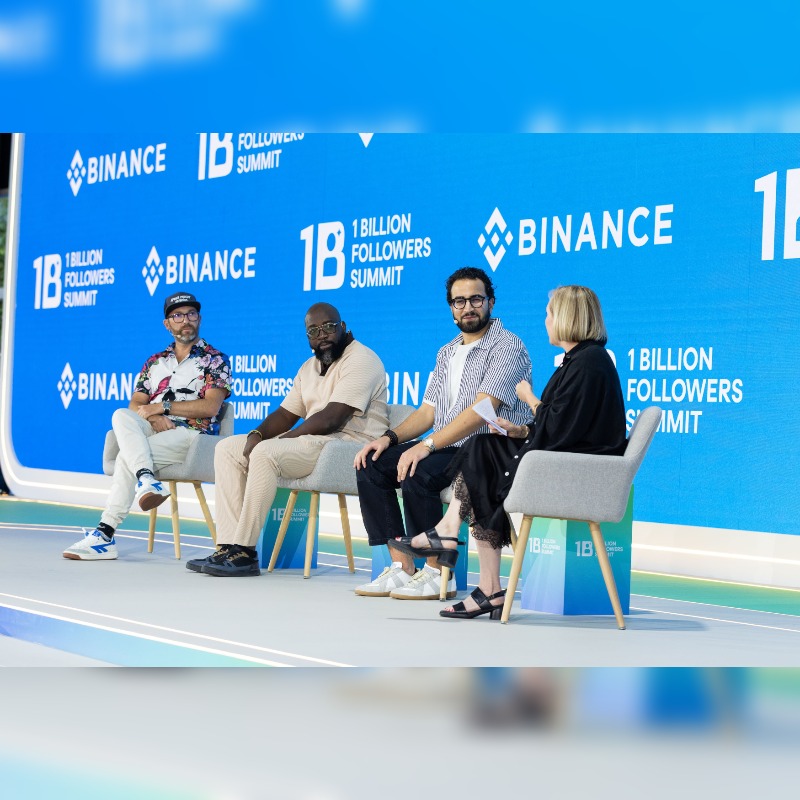
1 Billion Followers Summit: Local Creators Take Center Stage In Defining Future Of Entertainment
The rapidly growing local creator economy is reshaping the future of global content creation through culturally grounded innovation, community-driven platforms, and audience-first storytelling, industry leaders said during a session on the first day of the 1 Billion Followers Summit, the world’s largest summit dedicated to the content creation economy.
The session, titled “Why Local Creators Will Kill Hollywood,” examined how creator-led ecosystems are challenging traditional entertainment models and offering a new, scalable blueprint for the creator economy.
The discussion featured Bernard Kaufi Sokpe, Co-Founder of Jumble Spaces; Brett Dashevsky, Co-Creator of Siftsy; and Jon Savage, CEO of Africa Podcast Network. Speakers shared insights into how local creators are building platforms, tools, and collaborative communities designed specifically for the cultural, economic, and audience realities of the continent.
Panelists noted a surge in creator-led innovation driven by deep cultural diversity and local context. They highlighted that many global creator tools and legacy entertainment models fail to address these realities, prompting local innovators to build solutions from the ground up. This locally driven approach, they said, is shaping a creator-economy model that is evolving faster and more organically than traditional global markets.
The session also highlighted the role of capacity-building initiatives, including the African Digital Creator Academy, in helping creators strengthen their digital presence and advance creative and music agendas outside conventional industry frameworks. By focusing on direct audience engagement and platform-native growth, creators are scaling without reliance on traditional intermediaries.
Access to collaborative creative spaces was identified as a key growth driver.
Speakers emphasised that creators no longer need to relocate to traditional entertainment hubs such as Hollywood to succeed. Instead, local ecosystems enable creators to collaborate, exchange knowledge, and grow together—empowering emerging talent to negotiate contracts, speak at global events, and build sustainable careers while fostering visibility, motivation, and community.
Drawing on firsthand experience, panelists stressed that the creator economy operates fundamentally differently from traditional entertainment. In the digital creator space, audiences—not institutions—are the primary gatekeepers. Success is driven by storytelling, consistency, and innovation, rather than approvals from commissioning executives or legacy platforms.
The discussion also addressed the future of Hollywood, with speakers agreeing that traditional entertainment is not disappearing but undergoing a major transformation. They emphasised that the creator economy cannot be acquired or controlled using legacy approaches, underscoring the need for authentic partnerships that respect creator autonomy. While creators value independence, many welcome collaboration with traditional media when built on shared value.
Global parallels were explored, with speakers pointing to cities such as New York as historic hubs where technology, finance, and creativity intersect. Unlike traditional models that separate these sectors geographically, the creator economy allows this convergence to be replicated anywhere, with each city and region leveraging its unique cultural identity to attract engaged audiences.
Panelists also highlighted shifting consumption patterns, noting that audiences under 35 years now spend significantly more time on platforms such as YouTube and TikTok than on traditional television. At the same time, content production budgets have declined sharply compared to legacy Hollywood models, lowering barriers to entry and enabling broader participation in the creator economy.
Concluding the session, speakers emphasised that no two creator communities are alike. Each ecosystem is shaped by its cultural nuances, allowing creators to tailor content, formats, and business models to their audiences—one of the defining strengths of the global creator economy and a key theme of discussions on the opening day of the 1 Billion Followers Summit.