

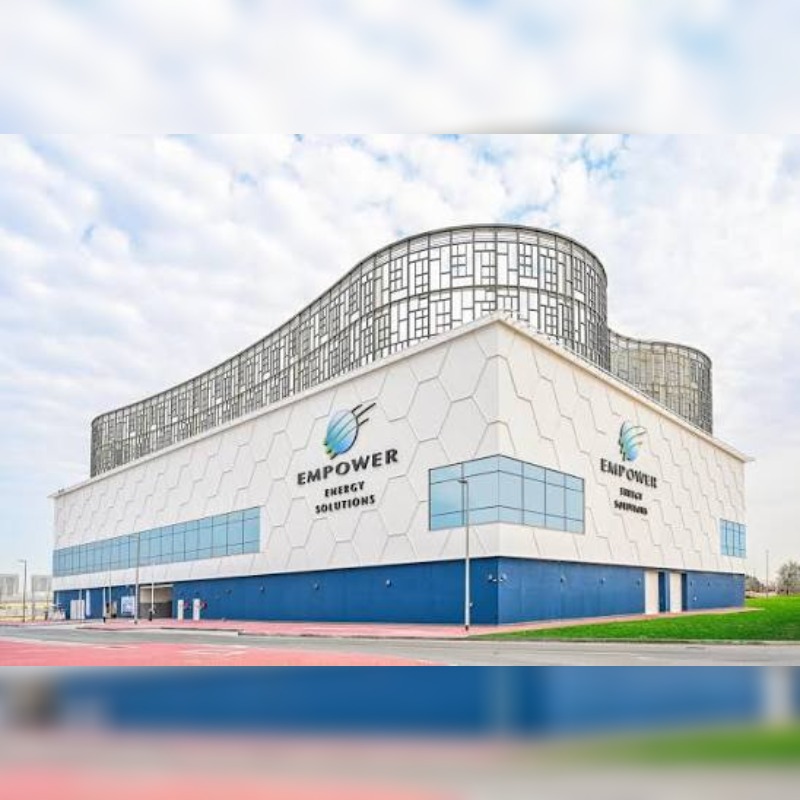
The Invisible Utility Cooling Dubai’s Towers, Airports and Mega-Developments
Dubai’s skyline depends on an infrastructure system most residents rarely think about.
Cooling.
In a city where summer temperatures can exceed 40 degrees Celsius, air conditioning is not simply about comfort.
It is essential infrastructure.
Homes need it.
Hotels need it.
Hospitals, shopping malls, offices and airports cannot function without it.
The traditional approach is straightforward.
Each building installs and operates its own cooling equipment.
Empower has built a different model.
Instead of every tower producing chilled air independently, large central plants generate chilled water and distribute it across entire districts.
The system is known as district cooling.
And Emirates Central Cooling Systems Corporation, better known as Empower, has become the largest district cooling provider in the world by connected capacity.
Its infrastructure now sits underneath some of Dubai’s most important neighbourhoods and landmarks.
District Cooling Works Like a Utility
The concept resembles electricity or water distribution.
A central facility produces chilled water.
That water travels through insulated underground pipes.
Individual buildings use it to cool their internal air.
The warmer water then returns to the plant to be chilled again.
The system removes the need for every building to operate its own large central cooling plant.
This centralisation creates opportunities for much greater efficiency.
Large facilities can use equipment more efficiently than thousands of separate installations.
Cooling Is One of Dubai’s Largest Electricity Uses
In hot climates, air conditioning represents a major share of electricity demand.
During summer afternoons, cooling systems across the city operate simultaneously.
This creates enormous pressure on the power grid.
Reducing the amount of electricity required for cooling therefore has national significance.
It can reduce peak electricity demand.
It can lower the need for additional generation capacity.
It can reduce emissions.
For Dubai, district cooling is therefore part of energy policy as well as property infrastructure.
District Cooling Can Use Far Less Electricity
Empower states that district cooling can reduce electricity consumption for cooling by up to approximately 50 percent compared with conventional air-cooled systems.
This improvement comes from scale and technology.
Large central chillers can operate more efficiently.
Thermal-storage systems can produce cooling during off-peak periods and use it later.
Equipment can be optimised across many buildings rather than one tower at a time.
In a city containing thousands of high-rise buildings, the cumulative savings can become enormous.
Density Makes the Model Work
District cooling performs best in dense developments.
A central plant needs enough nearby demand to justify the network of underground pipes.
Dubai provides ideal conditions.
Business Bay contains dense residential and commercial towers.
Palm Jumeirah contains hotels, apartments and villas.
Meydan and other major developments concentrate significant cooling demand within defined areas.
The more customers connected to a plant, the more efficiently fixed infrastructure can be used.
Urban density therefore becomes a competitive advantage.
Empower Was Established in 2003
The company was created as Dubai began expanding rapidly.
New master developments required enormous amounts of cooling.
Instead of relying entirely on conventional systems, Dubai began integrating district cooling into major communities from the development stage.
Empower grew alongside this construction boom.
Its infrastructure became part of new districts before many buildings were completed.
This is important because district cooling is much easier to implement when planned early.
Retrofitting existing neighbourhoods can be more complicated.
The Network Has Reached Extraordinary Scale
By 2026, Empower served more than 150,000 customers across well over 1,700 buildings.
Connected capacity had risen above 1.7 million refrigeration tons.
Contracted capacity exceeded two million refrigeration tons during the first half of 2026.
A refrigeration ton is a standard unit used to measure cooling capacity.
At this scale, Empower operates the equivalent of a massive distributed cooling utility.
Its network includes dozens of district-cooling plants across Dubai.
Contracted Capacity Provides Future Growth Visibility
Connected capacity represents buildings already using the system.
Contracted capacity includes developments that have signed agreements but may not yet be fully connected.
The gap between the two provides a pipeline.
As new buildings are completed, contracted cooling demand turns into connected capacity and eventually revenue.
This gives Empower greater visibility than a utility starting every year with no idea where new customers will come from.
Many developments have already committed to the network.
H1 2026 Added More Than 73,000 Refrigeration Tons
Empower signed 61 new contracts in the first half of 2026 covering approximately 73,415 refrigeration tons of additional capacity.
These contracts came from developments across Dubai.
Every new agreement potentially represents years or decades of future cooling demand.
Once a large building is physically connected to a district network, switching providers is difficult.
The infrastructure creates long-term customer relationships.
Long Contracts Make Revenue Relatively Predictable
District cooling is not a discretionary consumer product.
A hotel cannot decide to stop buying cooling because the economy slows.
An occupied residential tower still requires air conditioning.
Office buildings still need temperature control.
This makes demand relatively defensive.
The customer may use more or less cooling according to weather and occupancy, but the underlying requirement remains.
Long-term agreements add another layer of predictability.
Revenue Comes From More Than Consumption
District-cooling tariffs often include both capacity-related and consumption-related charges.
Capacity charges compensate the provider for making cooling infrastructure available.
Consumption charges reflect actual usage.
This structure helps balance revenue.
Even if a mild period reduces cooling consumption temporarily, contracted capacity still has economic value.
The model resembles other utilities where customers pay partly for access to infrastructure and partly for what they consume.
Summer Is Naturally the Most Important Season
Cooling demand rises sharply during hotter months.
Dubai’s summer therefore drives a significant portion of annual consumption.
Temperature changes influence revenue.
Tourism and hotel occupancy matter as well.
A hotel operating near full capacity uses more cooling than one with fewer guests.
This creates seasonality.
But unlike many seasonal businesses, Empower’s assets operate year-round and are tied to long-lived developments.
H1 2026 Revenue Reached AED 1.52 Billion
Empower reported revenue of approximately AED 1.519 billion during the first half of 2026.
That represented year-on-year growth of 4.5 percent.
EBITDA reached AED 773 million, rising 7.5 percent.
Net profit after tax reached approximately AED 468 million.
Profit grew considerably faster than revenue.
This suggests improving operating efficiency and favourable financing or cost dynamics.
EBITDA Margins Remain Extremely Strong
An EBITDA figure of AED 773 million on AED 1.519 billion of revenue implies a margin above 50 percent.
That demonstrates the attractive economics of mature district-cooling infrastructure.
Plants require substantial initial investment.
Once capacity becomes highly utilised, additional connected buildings can generate attractive incremental returns.
This is similar to other network utilities.
The most difficult stage is building the infrastructure.
The economics improve as more customers use it.
Dubai’s Property Development Is the Main Growth Engine
Empower’s future demand is closely linked to construction.
New residential towers require cooling.
Hotels require cooling.
New malls, hospitals and offices all increase potential connected capacity.
Dubai’s strong property-development pipeline therefore creates direct opportunities.
The company can grow by signing projects long before residents move in.
This makes it a less visible beneficiary of Dubai’s real-estate boom.
Empower Does Not Need to Take Property-Sales Risk
A developer may worry about whether apartments sell at the expected price.
Empower generally faces a different risk.
It supplies an essential service once the development becomes operational.
The company therefore benefits from property growth without needing to speculate directly on property values.
This can create a more defensive exposure to urban development.
Palm Jumeirah Became a Major Part of the Portfolio
One of Empower’s transformational acquisitions was Palm District Cooling.
The deal significantly increased connected capacity and gave the company exposure to one of Dubai’s best-known developments.
Palm Jumeirah contains hotels, residences and entertainment venues with substantial cooling requirements.
Large acquisitions of established infrastructure can accelerate growth far more quickly than constructing new networks entirely from scratch.
Meydan Added Another Strategic Area
Empower later acquired district-cooling assets serving Meydan.
Meydan has developed into a major residential and mixed-use growth corridor.
Owning cooling infrastructure in developing areas gives Empower long-term exposure to future construction.
As new buildings connect, utilisation increases.
The original acquisition can therefore become more valuable as the surrounding district matures.
Dubai International Airport Is a Unique Asset
Empower also acquired district-cooling infrastructure serving Dubai International Airport.
Airports have enormous cooling requirements.
Terminals operate continuously.
Large interior spaces need climate control.
Passenger volumes are substantial.
Unlike an office building, an airport operates through the night and throughout the year.
This creates a different demand profile from residential or commercial districts.
It also diversifies Empower’s customer base.
Airports Demonstrate Why Reliability Matters
A cooling failure in an ordinary building is inconvenient.
A major failure inside one of the world’s busiest airports could disrupt thousands of passengers and employees.
Infrastructure reliability is therefore essential.
Empower reports reliability close to 100 percent across its network.
Redundancy, maintenance and real-time monitoring are required to maintain that standard.
Utility customers rarely think about reliability until it disappears.
Centralised Control Improves Operations
Empower monitors facilities through centralised control systems.
Operators can observe plant performance continuously.
Data reveals electricity consumption, water use, temperatures and equipment status.
This allows problems to be detected earlier.
Digital monitoring also makes optimisation possible.
Plants can adjust output according to changing demand.
This is more efficient than running every unit at constant capacity.
AI Could Make Cooling Even Smarter
Artificial intelligence can improve demand forecasting.
A system could analyse weather forecasts, historical usage and building occupancy.
Plants could prepare for expected demand before it arrives.
Predictive maintenance could identify machinery at risk of failure.
AI can also help optimise which chillers operate at any moment.
Because cooling consumes so much electricity, even small efficiency gains can create large financial and environmental benefits.
Thermal Energy Storage Changes When Electricity Is Used
District cooling can use thermal energy storage systems.
These facilities create chilled water or ice during periods when electricity demand is lower.
Stored cooling is then used during peak periods.
This helps reduce pressure on the power grid.
The total amount of cooling delivered may be similar, but the timing of electricity use changes.
That flexibility is valuable to the wider energy system.
Water Efficiency Is Also Critical
Cooling systems consume water.
In an arid country, this matters.
Empower has invested in water treatment and reuse technologies.
The company has set objectives around greater use of recycled water.
Reducing dependence on potable water improves sustainability and can reduce operating costs.
Dubai’s cooling challenge is therefore linked to both electricity and water management.
Treated Sewage Effluent Can Become a Resource
Treated wastewater is unsuitable for drinking but can be useful in industrial applications.
Using treated sewage effluent for cooling reduces pressure on fresh-water resources.
This turns one urban waste stream into an industrial input.
As cities become more focused on circular resource use, systems such as this become increasingly important.
District cooling can therefore connect with broader water-recycling strategies.
District Cooling Supports Dubai’s Net-Zero Goals
The UAE has committed to Net Zero by 2050.
Buildings form a significant part of urban emissions.
Improving cooling efficiency is one of the most practical ways to reduce energy consumption in a hot climate.
Empower’s expansion therefore aligns directly with national climate objectives.
The company does not need to invent a futuristic technology to contribute.
It can reduce emissions simply by replacing less efficient cooling systems with a more efficient existing model.
The Business Has Strong Barriers to Entry
District cooling requires major capital and underground infrastructure.
Once pipes are installed and buildings are connected, competition inside the same area becomes difficult.
It would rarely make economic sense for another company to build a duplicate network beside an existing one.
This creates local monopolistic characteristics.
Regulation therefore becomes important to balance customer interests with infrastructure economics.
The IPO Opened the Business to Public Investors
Empower listed on the Dubai Financial Market in November 2022.
The offering formed part of Dubai’s broader programme to list major government-linked companies.
DEWA remains the dominant shareholder.
The listing gave investors direct access to an infrastructure business linked closely to Dubai’s population and property growth.
It also brought greater public visibility to an industry most residents rarely considered.
Dividends Are Central to the Investment Case
Utilities with mature assets often generate substantial recurring cash flow.
Empower has committed to significant annual dividend distributions.
For investors, this creates a combination of growth and income.
Connected capacity can increase as Dubai develops.
At the same time, existing assets generate cash capable of supporting dividends.
That combination distinguishes infrastructure companies from many early-stage growth businesses.
International Expansion Could Be the Next Frontier
Empower’s expertise is not unique to Dubai’s climate.
Cities across Saudi Arabia, the Gulf and other hot regions face similar cooling challenges.
Large master-planned developments are being constructed across the region.
District cooling can be especially attractive when infrastructure is designed from the beginning.
Empower has explored international opportunities, including Saudi Arabia.
Exporting operational expertise could become an important future growth route.
Saudi Mega-Projects Are a Natural Opportunity
Saudi Arabia is investing heavily in new cities, tourism destinations and mixed-use developments.
Many of these projects require enormous cooling capacity.
District cooling can be incorporated during planning rather than retrofitted later.
This is precisely the environment where an experienced operator can add value.
If Empower successfully expands abroad, it could turn Dubai-developed utility expertise into a regional export.
Why Empower Matters
Empower illustrates how essential infrastructure can hide in plain sight.
Millions of people walk through cooled buildings without thinking about where that cooling comes from.
Yet in Dubai’s climate, the system is fundamental to daily life.
Empower now serves more than 150,000 customers across thousands of buildings, with connected capacity above 1.7 million refrigeration tons and contracted capacity above two million.
Its H1 2026 revenue reached approximately AED 1.52 billion and net profit approximately AED 468 million.
The company’s significance, however, goes beyond financial performance.
As Dubai continues building denser communities, cooling demand will rise.
If that demand can be met using less electricity and more efficient water systems, district cooling becomes an important part of sustainable urban growth.
Empower’s business is therefore based on something Dubai will need regardless of how its economy changes.
Keeping the city cool.
Contributed by GuestPosts.biz.